
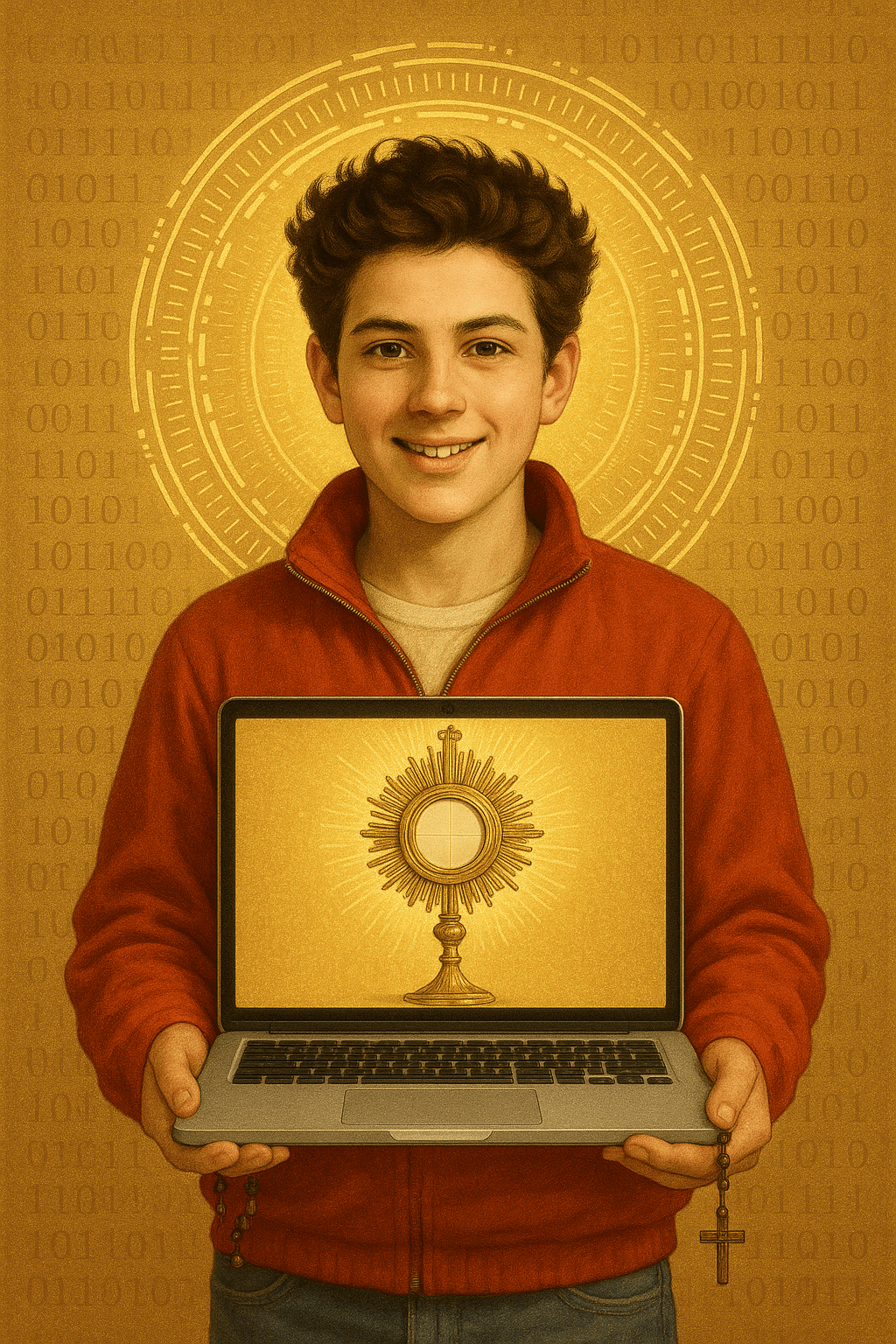
Not long ago, I attended a parish Mass where relics of Blessed Carlo Acutis were being venerated. The church was full, the music was simple, and the procession felt slow and sacred. When the relics were brought forward—bone fragments housed in gold—it struck me that I was in the presence of something ancient, something real, and something radically contemporary.
Carlo Acutis, born in 1991 and beatified in 2020, is known not for martyrdom or miracles in life, but for his devotion to the Eucharist, his skills with computers, and his joyful, holy normalcy. His relics—small pieces of his earthly body—seemed to say what the Church has always said: Holiness is not a relic of the past. It is now. It is possible. It is near.
The Theology of Relics: Matter Matters
To the modern mind, relics can seem odd or even superstitious. Why venerate bones? Isn’t this medieval? But Catholic theology has always insisted that grace is mediated through the material—not just symbols, but real contact with sanctified reality.
Just as the sacraments use water, bread, and oil, relics remind us that the body matters. Carlo’s relics, like those of saints throughout history, are not magic—but they are witness. They are physical evidence that God’s grace has truly transformed a human life, down to the marrow.
“In the holy relics of the martyrs and saints,” wrote St. Jerome, “we recognize the triumph of Christ in their members.”
This theology resonates deeply with someone like me, a woman working in tech. We spend so much of our lives disembodied, online, abstracted. Yet here was a relic—a young man’s body—testifying to something beautiful: sanctity is embodied, and it is for this generation too.
A Saint for the Digital Church
Carlo Acutis created websites about Eucharistic miracles when most teens were posting on MySpace. He taught himself to code, documented his travels, and played Pokémon. But beneath the digital surface was a contemplative heart shaped by prayer, the Rosary, acts of charity, and daily Mass.
He wasn’t famous. He wasn’t flawless. But he was awake to God, and he lived his life as though Jesus in the Eucharist was the center of the universe—because for him, He was.
The relics at the altar felt like more than history. They felt like invitation.
Eucharistic Devotion in an Age of Distraction
Carlo’s legacy is inseparable from his love for the Eucharist. He once said:
“We are more fortunate than the Apostles who lived with Jesus 2,000 years ago. To be with Jesus in the Eucharist is even better!”
That kind of bold, countercultural Eucharistic devotion isn’t always popular. Even among Catholics, many are unsure what the Eucharist truly is. Yet in a world increasingly addicted to instant gratification, digital stimulation, and dopamine loops, the Eucharist invites us to stillness, presence, and real communion.
When I knelt during that Mass, with Carlo’s relics close by, I found myself praying:
“Lord, teach me to hunger for You the way he did.”
✨ Personal Reflection: A Woman in Tech Meets a Boy Who Got It
I work in technology. I love what I do. But sometimes I feel spiritually scattered—my attention fragmented, my soul buzzing. It’s hard to stay rooted when everything is moving.
Carlo reminds me that sanctity is not about withdrawing from the world—it’s about infusing the world with God’s presence, even through code. He inspires me to use my keyboard like a rosary, my server logs like spiritual journals, my screens like stained glass—transparent to the Light.
Seeing his relics reminded me that it’s not impossible to be holy in tech. It’s necessary. The internet needs saints.
And we may not all be beatified, but we’re all called.
Relics and Resurrection: Not Just Memory
Relics also remind us of a truth often overlooked: the resurrection of the body is not a metaphor. Carlo’s bones, like yours and mine, are destined not for oblivion but glory. The relics aren’t just leftovers. They are seeds of immortality.
This is deeply Eucharistic. As we eat Christ’s body in the Eucharist, we are being made into His Body—mystically now, and physically in the resurrection.
In a world where everything is virtual, where AI can mimic presence but never give it, relics are real. They testify to flesh, faith, and the future.
The Liturgical Moment
The Mass that day was simple but radiant. There were no digital screens, no innovations. Just Word, Sacrament, and the quiet procession of sanctity. When I received Communion, I felt not just nourished, but challenged. I had just knelt near the bones of someone my age—someone who loved Jesus more than anything.
And Jesus, in that moment, was in me.
The relics reminded me that the Eucharist is not a concept. It is a person, truly present. And sanctity is not a special achievement—it’s a response. A “yes.” A click into grace.
Conclusion: Carlo’s Legacy and the Call to Holiness
I left that church feeling lighter, but also more focused. Carlo Acutis isn’t a saint because he was a tech whiz. He’s a saint because he loved well, with all his heart, and never let his gifts—digital or otherwise—become distractions from his first love: Jesus.
His relics spoke without words:
“This could be you.”
And perhaps that’s the greatest miracle of all.
👨🏫 CHURCH SOURCES & PATRISTIC QUOTES
- Catechism of the Catholic Church, §§1322–1419 (Eucharist)
- Pope Francis on Carlo Acutis: “He didn’t rest in comfortable inertia… he grasped the needs of his time.”
- St. Augustine: “Become what you receive.”
- Vatican Bio on Carlo Acutis
- Miracle of the Eucharist Website by Carlo
- Blessed Carlo Acutis Official Website



 Wired saints & theology
Leave a comment